Meta's new AI agent, Muse, can now plan and book a trip for you. I wanted to know how it actually does that, and what it means for the booking websites it sends people to. Here's what I found.
How does Meta's Muse book travel, and does it make booking sites less valuable?
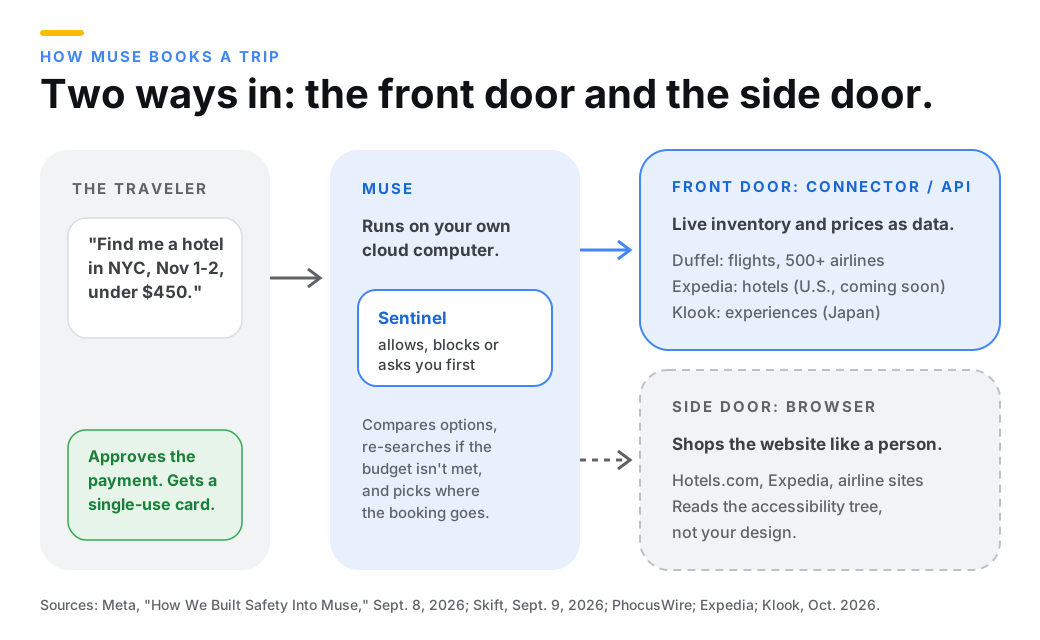
Muse, Meta's personal AI agent launched in the U.S. on September 8, 2026, books travel two ways. For flights it connects directly to Duffel's API, which covers more than 500 airlines, and pays with a single-use card from Stripe Link. For hotels at launch it used its own cloud browser to shop sites like Expedia and Hotels.com, reading each page's accessibility tree. Expedia and Klook have since signed on as connector partners. Meta has not said Muse uses A2A or MCP. Booking sites don't become worthless: their inventory, payments and service still matter. But the agent becomes the shopper, so the search pages and ads built for people matter less, and a site an agent can't read or connect to may never get picked.
AI Summary
Summary by AI- Muse, Meta's personal AI agent, launched in the U.S. on September 8, 2026. It plans and books travel, and each user gets a separate virtual machine with its own browser in Meta's cloud.
- Front door: for flights it connects directly to Duffel, a travel API with more than 500 airlines. Meta calls these direct partner integrations connectors. Expedia and Klook have since signed on.
- Side door: where there is no connector, Muse opens a browser and shops sites such as Expedia and Hotels.com. It reads the accessibility tree, not the raw page, and cannot run JavaScript.
- Meta has not said that Muse uses A2A or MCP. Today it uses partner connectors and a browser.
- For booking sites the risk is not irrelevance but selection: the agent chooses, and a site that is hard for an agent to read or connect to does not get picked.
- Suggested steps: make the site readable for agents, get in through a connector or API where there is real inventory, and prepare for agents that talk back.
What Muse Is
Muse is Meta's personal AI agent. You chat with it in the Muse app, on the web or in WhatsApp, and you give it jobs that take more than one answer: research a trip, compare options, book it, and keep an eye on it afterward. There's a free tier and paid plans at $20 and $100 a month. Meta says it won't run ads in Muse. Mark Zuckerberg said Meta expects to make money by taking a small fee on transactions.
It's getting used. According to 24/7 Wall St., Muse reached 560,000 daily active users in its first 11 days.
How It Works Today
The part I found most interesting is the setup underneath. Every Muse user gets their own computer in Meta's cloud, a separate virtual machine with its own browser. You can watch the browser while Muse works.
Meta published a detailed post on how it built this. A few things stood out to me.
- A separate system called Sentinel decides every action Muse takes. Muse proposes something, and Sentinel allows it, blocks it, or asks you first. Your approvals go straight to Sentinel, not through the chat, so the model can't talk itself into permission.
- When Muse pays, it gets a single-use card number tied to one merchant, one dollar amount and a short time window. For flights, that runs through Stripe Link.
- When Muse browses, it doesn't see your website the way you do. In Meta's words, it "sees an accessibility tree snapshot of the page, not the raw DOM," and it can't run JavaScript on the page.
That last point matters a lot for anyone with a website. I'll come back to it.
From there, Muse has two ways to book. I think of them as a front door and a side door.
The Front Door: APIs and Connectors
For flights, Muse connects directly to Duffel, a travel API company in the U.K. Duffel gives Muse live, bookable fares from more than 500 airlines, and it handles the booking, changes and support afterward. That's a real data connection with a business relationship behind it.
Meta calls these direct connections connectors. Meta says that for each one, it worked with the company to integrate its API. At launch, the list included Gmail, Google Calendar, Outlook, OpenTable and Plaid. On September 23, Meta added commerce partners including Expedia, Shopify, Walmart, Best Buy, Sephora and Instacart. Expedia says hotel booking through Muse is coming soon in the U.S. On October 23, Klook connected 426,000 bookable experiences to Muse in Japan. Muse lines up the order, the traveler pays on Klook's own payment page, and the confirmation comes back into the chat.
On September 18, Meta opened a page where any business can submit a connector for review. What it hasn't published is an SDK or an API spec. And Muse can also build a custom connector for a single user from any service that has an API.
The Side Door: The Browser
Where there's no connector, Muse uses its browser. When Skift tested it the day after launch, hotel searches went this way. Muse opened sites like Expedia and Hotels.com, searched, compared, and decided which site got the booking. For flights, Muse can also book on an airline's own site, pausing for you to log in or approve.
Not everyone is fine with this. On September 21, Amazon blocked Muse from its store. Amazon said Meta never told it, and that the agent didn't identify itself. Shopify went the other way and let Muse onto its stores.
So Does It Use A2A or MCP?
Not that Meta has said. I looked. I couldn't find A2A or MCP mentioned in Meta's security write-up, its developer page or the launch coverage. What Muse uses today is partner APIs (connectors) and a browser.
That's worth knowing, because A2A is the protocol built for exactly this: one company's agent talking to another company's agent. It's how our own agent works. You can send it to a website and watch it try to start a conversation on our A2A page. Muse isn't doing that yet. It talks to APIs that partners wired up with Meta one at a time, and it reads everyone else's website. If Meta opens Muse up to standard protocols later, any site with an agent could talk to it directly. For now, you get in through a connector or you get read.
Does This Make Booking Sites Less Valuable?
This was the real question for me. My answer is that some of what a booking site does gets less valuable, and some of it gets more valuable.
What gets less valuable is the front of the site. The homepage, the search box, the filters, the ranking, the ads and the upsells. All of that was built to win a person's attention. When an agent does the shopping, nobody sees it. Skift made a point I hadn't thought about, too. On the browser path, the site still pays for all those searches. An agent that keeps re-searching until it finds something under budget can run up a lot of searches for each booking.
What keeps its value is what's behind the page: the inventory, the prices, the payment and the service when something goes wrong. Klook's deal is a good example. Muse prepares the booking, but Klook still owns the payment and the booking record. The way Contentgrip put it: "The travel agent is becoming an interface, but the shelf behind it is still an inventory system."
The two biggest online travel companies are betting different ways. Expedia partnered with Muse. Booking Holdings stayed out. When analysts at Truist cut their price targets on both stocks on October 1, they called the effect on bookings "highly uncertain." And right now the traffic is small. AI chat tools account for well under 1 percent of Booking's room nights, and its direct bookings have held in the mid-60 percent range. Most independent hotels still need Booking to be found at all.
So I don't think booking sites become worthless. I think the customer they're selling to changes. More and more, they're selling to the agent. And as Contentgrip also wrote, "When the assistant narrows the market, omission becomes the new form of invisibility." If the agent doesn't pick you, the traveler never hears your name.
What I'd Do If I Ran a Booking Site
If I ran a hotel, an airline or any site where people book, I'd do three things.
- Make sure an agent can read your site. Muse reads the accessibility tree, the same structure a screen reader uses. If your prices, dates and rooms are buried in scripts or images, an agent may not see them. That's exactly what we built MachineReady to check. It shows you your site the way a machine reads it.
- Get in through the front door. If you have real inventory, talk to the platforms about a connector or an API. Being a structured, bookable source beats being scraped.
- Be ready for agents to talk back. Muse doesn't speak A2A yet, but the protocol exists and other agents do. In Does Your Website Need to Speak Agent? I wrote that booking sites, stores and marketplaces should plan for this first. Muse is the reason why.
If you want a quick read on where your own site stands, paste this into ChatGPT, Claude or whatever you use.
The Agent Is the New Front Page
For twenty-five years, booking sites competed to be the page people landed on. Muse is an early sign that the agent is becoming that page. The sites that keep their value will be the ones agents can read, connect to and trust. The rest will still exist. They just won't get picked.
If you're new to agents, the AI agents series is a good place to start, and Why Every Website Now Needs Three Interfaces explains why a site now has to work for people and machines.
Can an agent like Muse read your website? Check your site with MachineReady, see an agent-to-agent conversation on our A2A page, or get in touch with Dan Seyer.
*Sources: Meta, "How We Built Safety Into Muse," Tarek Sheasha, September 8, 2026. Skift, "Meta Says Its Muse Agent Books Travel. Here's How It Works," September 9, 2026. PhocusWire, "Meta launches AI agent with travel booking capabilities," September 2026. TechCrunch, September 23, 2026, and GeekWire, September 21, 2026, via Wikipedia. Travel Noire on the Expedia partnership, September 28, 2026. Contentgrip on the Klook partnership, October 23, 2026. 24/7 Wall St., "How Booking Holdings and Expedia Are Taking Opposite Bets on AI Shopping Agents," October 1, 2026.*
← Back to all articles