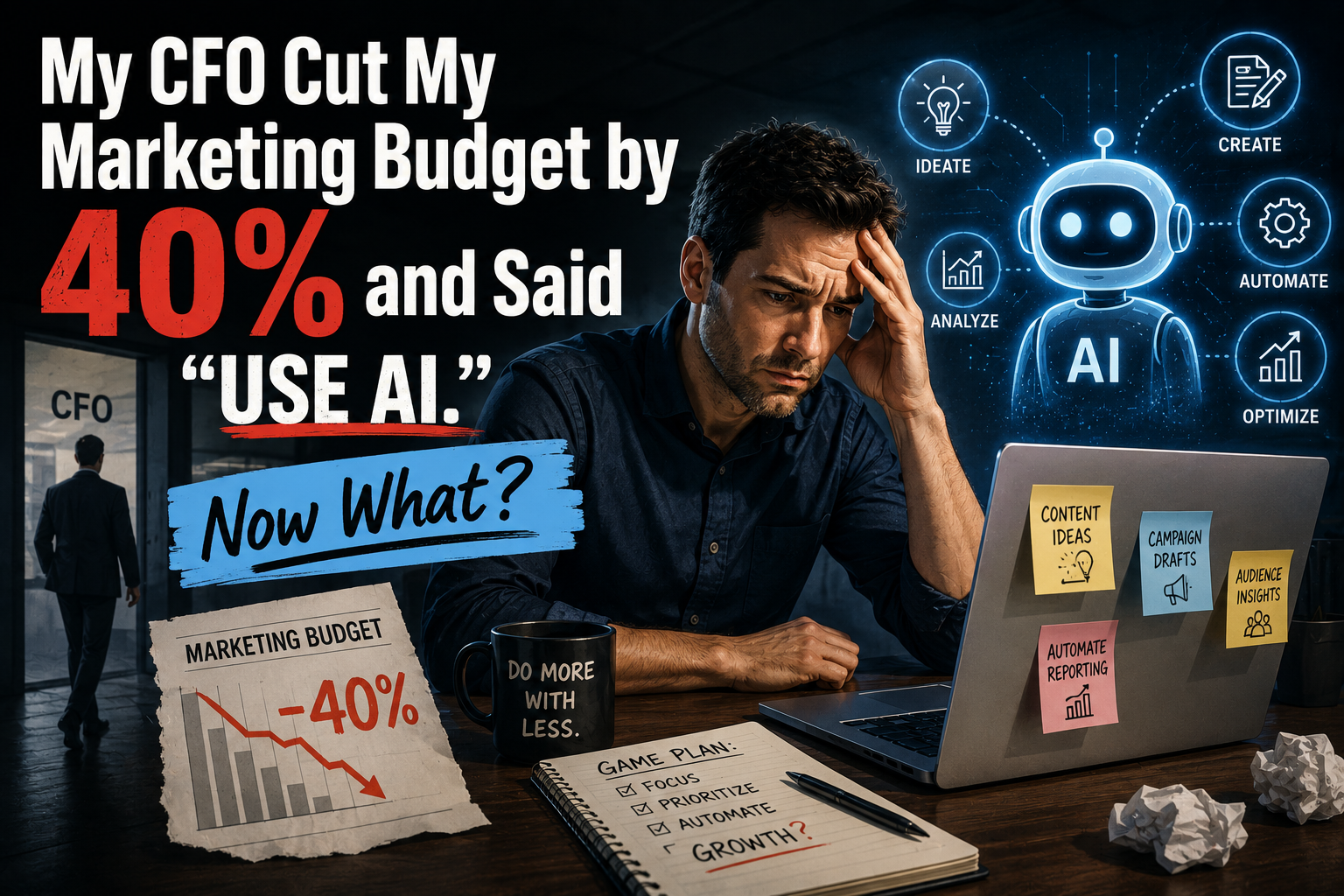
A strange tension is brewing inside marketing organizations right now. On one hand, AI has made us dramatically more productive. Campaigns move faster, research is compressed from days into hours, and content production that once required layers of coordination now happens in a single window. Yet, many companies aren’t seeing their marketing costs drop.
Why are CFOs cutting marketing budgets because of AI?
Because AI is changing the economics of marketing, not just its execution. For decades marketing scaled through labor: more campaigns meant more coordinators and more content meant more writers. Now research and first drafts that took weeks happen in an afternoon, and finance sees the operating leverage. The real shift is from channels to workflows. Teams that redesign how work moves, rather than plugging prompts into old systems, capture the gains. As content gets cheap, clarity, narrative and a real point of view become more valuable, and the marketing organization becomes smaller operationally but stronger strategically.
This is why a new, quiet conversation is emerging between the CFO and the CMO. It often starts with a sentence that lands like a grenade:
“We’re cutting the marketing budget by 40%. You have AI now.”
At first glance, this feels like finance fundamentally misunderstanding the reality of our work. AI doesn’t magically replace institutional knowledge, positioning strategy, or the human nuance required to hold a campaign together. But the finance team is responding to something real: AI isn’t just changing marketing execution; it’s changing marketing economics.
The End of Linear Scaling
For decades, marketing scaled through labor. More campaigns meant more coordinators; more content meant more writers; more reporting meant more analysts. Agencies expanded because production itself was expensive.
That equation is breaking. Marketing leaders whose teams used to spend three weeks preparing a competitive landscape for executive planning. They gathered research, assembled slides, and synthesized findings across dozens of vendors. Now, the "operational gravity" of that work has shifted. The first-pass research and synthesis happens in a single afternoon using AI-assisted workflows.
The strategic thinking and the final narrative still require a human, but the manual labor has vanished. Companies are reducing campaign launch timelines from a month to under a week because AI now handles the heavy lifting for message drafting, SEO recommendations, email structures, and reporting prep.
Nobody "disappeared" from the organization, but the shape of the work changed.
From Channels to Workflows
Many companies are still treating AI as a "tool" discussion. It’s actually an operating model discussion. The organizations gaining true leverage aren’t just plugging prompts into old systems; they are redesigning how work moves through the system itself.
Most marketing teams still think in channels: Social, Events, Paid Media, or SEO. But AI impacts workflows first, specifically research, approvals, and content transformation. Once you map these workflows, an uncomfortable truth emerges: an extraordinary amount of marketing labor has historically been trapped inside repetitive operational coordination.
CFOs are noticing. Not because they’ve suddenly become marketers, but because they see operating leverage. If AI compresses cycles and automates reporting, finance will eventually ask: "Where are the efficiency gains showing up?"
The New Value of Perspective
This shift will fundamentally change agency relationships. Agencies are continuing to bill identical retainers even after AI dramatically accelerated their production. Deliverables improved, but pricing stayed anchored to a pre-AI labor economy.
Productivity always changes faster than pricing structures, but finance eventually catches up. When they do, the conversation shifts from "How much content are we producing?" to "What operating leverage are we creating?"
In the AI era, activity becomes cheap. Publishing more content is no longer a differentiator, and generating more campaigns is no longer impressive. As the supply of content explodes, the value of human-led attributes, clarity, narrative, and an authentic point of view, skyrockets. Ironically, AI may be the very thing that increases the value of human storytelling.
The Leaner, Strategic Future
The standout companies of the next decade won’t be those producing the most content. They will be the ones communicating with the clearest perspective in an increasingly noisy market.
The future marketing organization will likely be smaller operationally but stronger strategically. We are moving toward a model defined by fewer manual workflows, a heavy emphasis on positioning, and a deeper focus on strategic communication.
The CFO might think they are just cutting the budget. In reality, they are unintentionally forcing the redesign of the modern marketing organization. That conversation is only beginning.
Want to talk this through for your company? Get in touch with Dan Seyer, or check how AI reads your website with MachineReady.
← Back to all articles