This article is for CMOs and marketing leaders deciding who on their team to invest in for the AI era, and for marketers who want to be one of those people. It draws on what the CMOs of Google, OpenAI and JPMorganChase said on a Cannes Lions 2026 panel.
Who are CMOs betting on in the AI era?
The marketers leaning into AI, whom Google CMO Lorraine Twohill calls makers and builders. They are curious, they build things that solve real problems, and they connect their work to the rest of the business. Google’s CMO weighs talent across toolsets, skill sets and mindsets, and says tools alone are not enough. These people are often junior team members who automated their own manual work, not the most senior or technical people on the team.
AI Summary
On a Cannes Lions 2026 panel, Google CMO Lorraine Twohill said the marketers leaning into AI are the ones leaders will bet on, and described them as makers and builders. Google's CMO thinks about talent in three buckets: toolsets, skill sets and mindsets, and tools alone are not enough. OpenAI's Colin Fleming called curiosity the most important skill. JPMorganChase's Carla Hassan said the leaders will be people who connect the dots across the business. Shiv Singh warned that a team is only as strong as its weakest member. Often the makers are junior people who automated their own manual work.
Who Are Your Makers?
The "Winning the AI Discovery Era" panel at Cannes Lions 2026 brought together the marketing chiefs of Google, OpenAI and JPMorganChase, along with Shiv Singh of AI Trailblazers, moderated by LinkedIn CMO Jessica Jensen. I've already written about what Google's CMO said about the product graph. Going in, I expected a conversation about strategy. A lot of the hour turned out to be about people instead: which people inside a marketing team these leaders are going to bet on.
Google's CMO, Lorraine Twohill, put it most directly. The people leaning in "are going to have an advantage," she said. "You can see it in the teams. I mean, they're the folks we're going to bet on." Then she named them: "We look at it as makers and builders. Who are our makers? Who are our builders?"
It describes a different kind of marketer than most org charts are designed around.
Toolsets, Skill Sets, Mindsets
Twohill described how she thinks about talent in three buckets: "Tool sets, skill sets, mindsets."
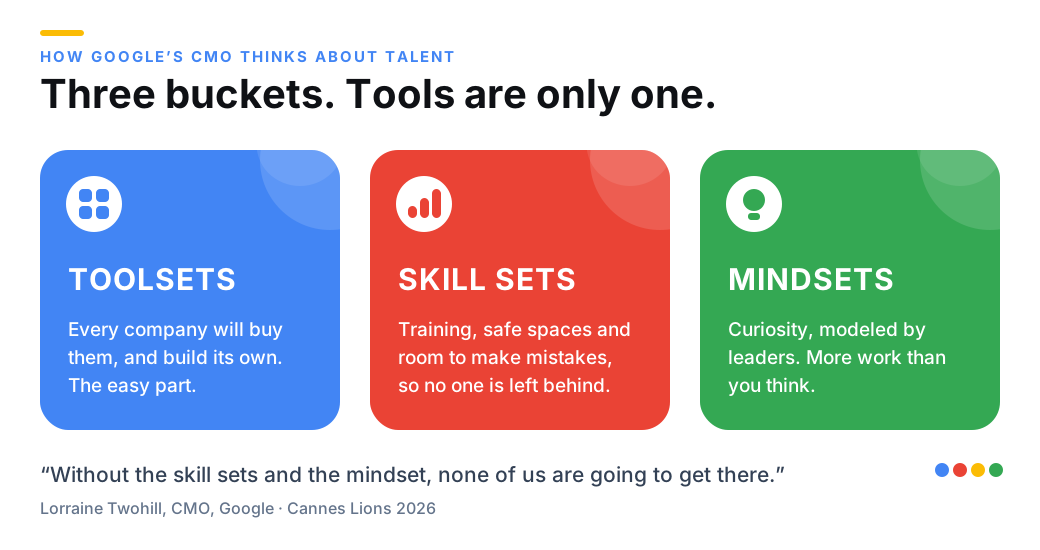
Tools are the easy part. Every company will buy them, and Google will build plenty of its own. Her point was that tools alone don't get anyone there: "Without the skill sets and the mindset, none of us are going to get there."
On skill sets, she was candid about the risk of leaving people behind, warning of an AI divide like the digital divide before it. Building skills, in her view, means creating safe environments, training, and the grace to make mistakes, at a time when deadlines are getting shorter, not longer. She noted that Google shipped around 100 products and features at a recent I/O event, and every one needed marketing support.
On mindset, she said the shift is "more work than you think," and that it comes from leaders modeling the behavior they want. She was blunt about what happens to those who don't: some leaders "won't make it through this because they're not modeling the right mindset for today."
Curiosity Is the Skill
OpenAI's Colin Fleming called curiosity "absolutely the most important skill set," and gave an example that shows what a maker actually does. New to his role and needing to understand OpenAI's audiences, he didn't commission a research study that would take a year. Over a weekend, he connected OpenAI's own tools to the company's sales call recordings and CRM and built a synthetic market research environment. The marketing team now runs ideas through it and gets feedback in real time.
He was careful to say this isn't about replacing people. It's about how fast a curious person can build confidence in a decision.
Shiv Singh pushed the point further. The tools are fascinating, he said, but "it's not even about the tools." What's coming is a world where systems of reasoning sit beside us for every decision. His advice to anyone who wants to stay ahead was to spend real time, including weekends, studying and building, because companies are moving much more slowly than the technology.
Connecting the Dots
JPMorganChase's Carla Hassan added a quality that's easy to overlook. Curiosity and mindset matter, she said, but the people who lead will be the ones with "the ability to connect all the dots." They see how one part of a process affects another. They reach out across teams even when it isn't their area. "They don't stay in their lane," she said.
That's an important counterweight to the image of a maker as a lone person building tools. The most valuable builders understand the whole system, from the customer to the campaign to the business outcome.
The Surprise: It's Often Not the Senior People
Earlier in the panel, one speaker made an observation that most senior leaders would rather not hear. The people solving the most problems with AI are often junior team members, doing the most manual work, who simply decided to automate it. They aren't technical. They're savvy, and they have "superpowers now." The speaker said they see this more among junior people than senior ones.
Shiv Singh drew the organizational lesson from his time as the digital leader at PepsiCo. Being the one person who understood the future gave him influence, he said, but the organization's "collective IQ wasn't rising." In the AI era, a team is "only as good and as strong as the weakest member," regardless of title.
It Felt Hard. It Isn't.
The most candid moments came when these leaders talked about using AI tools themselves. One wished the industry would be "more honest with each other and ourselves about how hard this is," after spending a weekend building something and having to phone a friend for help. Another tried a few creative AI tools, expecting to prompt, hit submit and get something perfect, and "had no clue" what they were doing. Someone put the balance at roughly 10 to 20 percent technology and 80 percent people: the anxiety, the confusion, and the question of who they are going to be as workers.
I understand why it felt that way. But it isn't actually hard. It's unfamiliar, and those are different problems.
There may also be an identity crisis underneath it. Am I a maker, a builder or a leader? I saw that question at Deloitte when I first started my career. Surprise: you're all three today. At least you will be in the age of AI.
The panel's own stories make the case. Carla Hassan described a young engineer on her marketing team who had spent about six months trying to build data products. Her team gave her a Claude license and told her to go play. Within five days, working with the data and analytics team and other marketers, she had built what she couldn't before, and she went from worrying about her job to being one of the most valuable people on the team. She had no special training. What she had was desire, curiosity and, most importantly, a goal. Without a goal, the tools are just something to play with. With one, a few days is often enough.
From there, what you have to do is believe it's possible, integrate the tools, commit to optimizing your workflows with AI, and do some of the work yourself. Integrating is what Colin Fleming did: rather than using one AI app on its own, he connected his tools to the company's data so they worked together, and Lorraine Twohill made the same point about end-to-end connection rather than point solutions. Committing means going back to each workflow, from research to content to reporting, and asking how AI can make it better, instead of trying a tool once. And doing the work yourself includes leaders. You can't judge what AI can do for your team, or recognize the makers on it, if you've never made anything with it yourself.
Because you won't believe any of this until you do it and see it for yourself. Once you do, it's like putting on x-ray vision. You start to see every workflow, every handoff and every manual step for what it could be, and how each one connects to the next. That's what Carla Hassan meant by connecting the dots.
And once you start to connect them, you won't believe the world you lived in before.
What the Panel Isn't Saying Yet
There's one thing I don't think the panel said out loud, at least not fully. Marketing organizations are about to focus on workflow improvement, no different from any other industrialization process.
Marketing has always been manual. As I wrote in My CFO Cut My Marketing Budget and Said: Use AI. Now What?, it scaled linearly: more campaigns meant more coordinators, and more content meant more writers. Now we can look at each workflow and ask a simple question: can a machine do this?
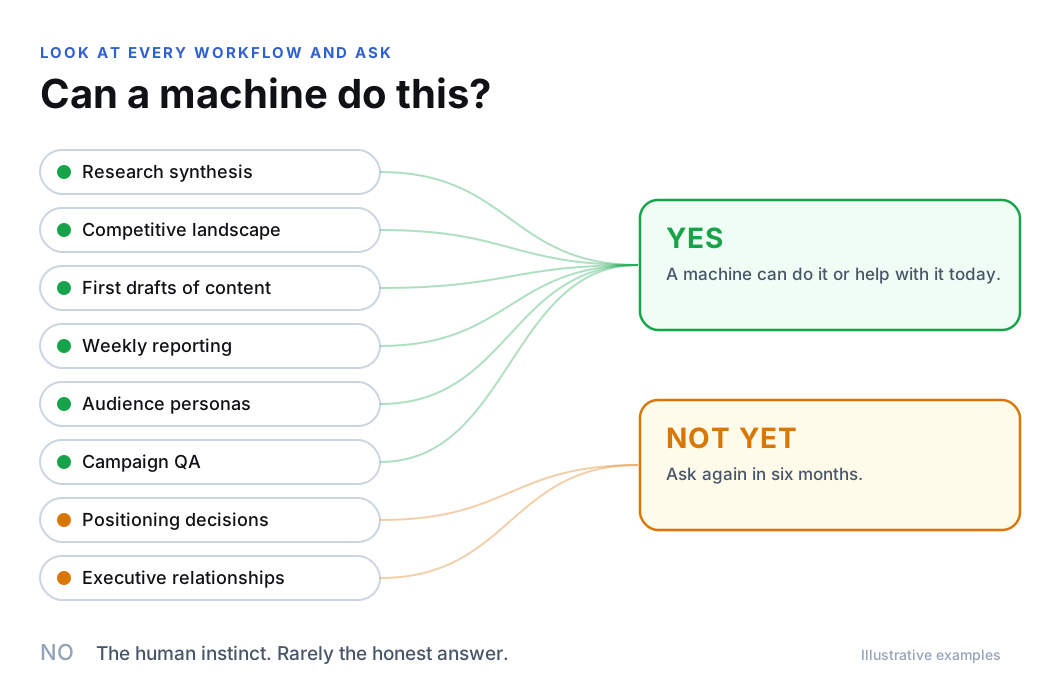
The human instinct is to say no. But the honest answer is either yes, or not yet. Job after job, machines will be able to help us, and that will make marketing teams smaller, smarter and much more capable.
That doesn't mean skipping steps. Carla Hassan made this point on the panel: everyone is so excited about the tools that they want to go as fast as possible, but building a marketing campaign "is still a process," and if you race past part of it, at some point "it is going to break." Her team has been deliberate about mapping the process end to end and understanding what needs to be automated. Going through the process is how marketing doesn't disappear. It transforms.
The people who lead that transformation will be the leaders of tomorrow, because they see how the whole process fits together. They won't just have better tools. They'll have made the tools, often during the same meeting where everyone else is still discussing them. It is that fast. And it gets easier with every project.
What This Means for Marketing Leaders
Listening to these leaders, I could feel a new archetype being appreciated. I call it the Marketing Super-Creator, a marketer who has moved beyond using AI to architecting it, diagnosing problems and building their own solutions with prompts, APIs and custom agents. None of the panelists used that term, but it was great to hear leaders at this level describe it in their own words. And none of them described a builder as an engineer. They described curious marketers who see a manual problem and fix it, who connect their work to the rest of the business, and who are willing to be wrong in public while they learn.
Every marketer has access to the same AI tools. The advantage goes to the ones who build with them.
If you lead a team, the practical question is the one Twohill asked: who are your makers, and who are your builders? A few ways to find out:
- Look for the people who have already automated part of their own job without being asked. They're your makers, whatever their title.
- Give them a real problem, an owner role and a way to measure it. One panelist described starting with "let a thousand flowers bloom," finding that some people built amazing things and others froze, and moving to owned jobs to be done with tools, a roadmap and metrics.
- Set guardrails so people can experiment safely. Another panelist called this "freedom within a framework."
- Watch for who is being left behind, and make it safe for them to start.
If you're the one hoping to be bet on, the panel's advice was consistent: get curious, build something real, and connect it to an outcome the business cares about.
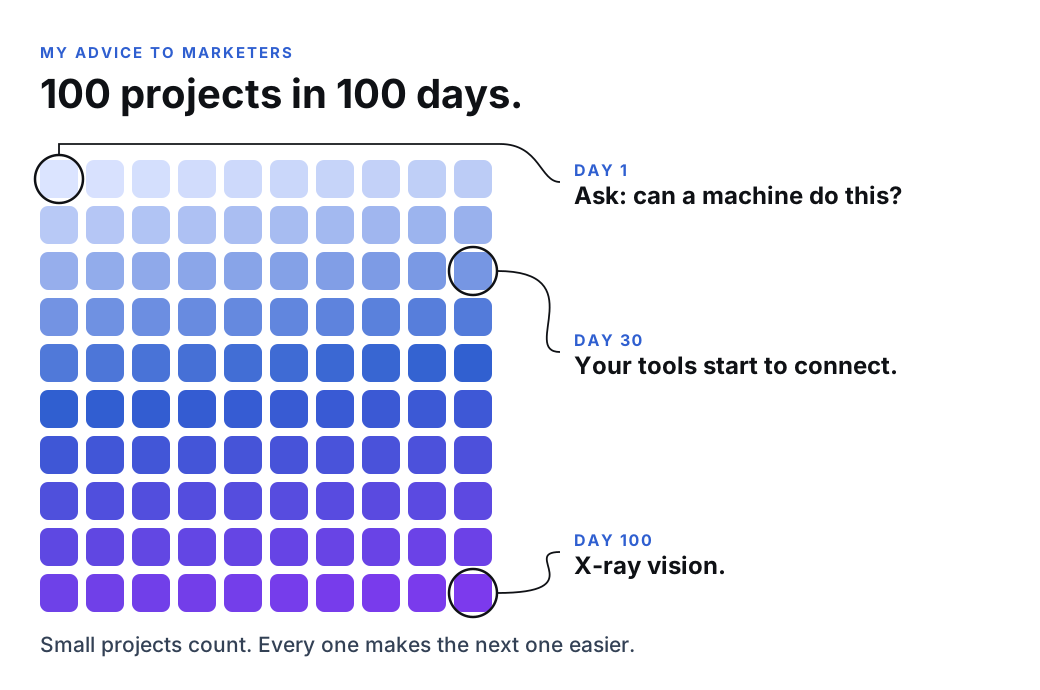
My advice goes one step further: take on 100 projects in 100 days. Pick a workflow each day and ask whether a machine can do it, or help with it. Small projects count. Every one makes the next one easier, and by the end you'll see your work, and your team's, with the x-ray vision this article is about.
To find out where you stand today, give this prompt to your favorite AI tool. It will interview you, tell you honestly whether you're leaning in, and plan your first projects.
Want to see what a marketing builder makes? Run MachineReady on your website, a tool we built to show how AI reads your site, or get in touch to talk about building AI into your marketing team.
*Source: "Winning the AI Discovery Era: Marketing to Minds and Machines," Cannes Lions 2026, with Colin Fleming (CMO, Business, OpenAI), Lorraine Twohill (CMO, Google), Carla Hassan (CMO, JPMorganChase), Shiv Singh (Co-Founder, AI Trailblazers) and Jessica Jensen (CMO, LinkedIn). Talent discussion at about 14:30 to 18:50 and 31:40 to 39:30 in the panel video.*
← Back to all articles