October is Cybersecurity Awareness Month. I spent years inside a cybersecurity firm, and today I help marketing teams build with AI. From where I sit, AI is now the biggest source of demand in the cybersecurity market.
Why is AI the biggest driver of demand in cybersecurity?
Because AI has made building software accessible to all Super-Creators. Marketing, sales and finance now build their own tools, agents and automations, and every new app, integration and API key widens the attack surface. Attackers got cheap AI too. IBM's 2026 breach study found one in four malicious breaches was AI-enabled, and Gartner expects spending on securing AI to grow 83 percent in 2026.
AI Summary
Summary by AI- AI has made building software accessible to everyone. Marketing, sales and finance now build their own tools, agents and automations without waiting for IT.
- Every new app, integration and API key is another door, and attackers got cheap AI too. The attack surface is growing faster than security teams can review it.
- IBM's July 2026 Cost of a Data Breach Report: one in four malicious breaches was AI-enabled, at $6 million each on average. Gartner expects spending on securing AI to grow 83 percent this year.
- Recommended steps: educate the new builders, write the security rules down where their AI can read them, review early and map the data flows, and ask vendors how they use AI.
Where I'm Coming From
In 2015 I left Google, which had just bought Jibe, to join Edgile and take a deep dive into cybersecurity.
From a public podcast interview. More in the Jibe hackathon story.
Edgile was a security consulting firm, and it was ripe for growth. I developed its positioning: "We secure the modern enterprise." We competed with the Big Four and won, because we brought in the best and the brightest. When Wipro announced it was acquiring Edgile in 2021, Edgile was working with 31 percent of the Fortune 100. (Edgile's CEO, Don Elledge, talks about why they invested in marketing.)
Security people taught me to ask a different question. Not "does it work?" but "what happens when someone uses it in a way you didn't plan for?"
But now we're in the AI acceleration era, and most of the people building at work don't ask that question.
Everyone Is a Builder Now
A year ago, a tool that pulled leads from the CRM, enriched them and drafted outreach went on the IT backlog. Today a marketer builds it in an afternoon with Claude, a few connectors and an API key. I know because we do it ourselves. I call these people Marketing Super-Creators.
And AI really is cheap, partly because the companies selling it have been spending more than they take in. Anthropic's IPO filing shows it spent about $2.76 to run the business for every $1 of revenue in 2025.
I'm all for it. But cheap AI means more business enablement, more enablement means more development and more integrations, and more integrations mean more security holes. The surface area of risk keeps getting wider.
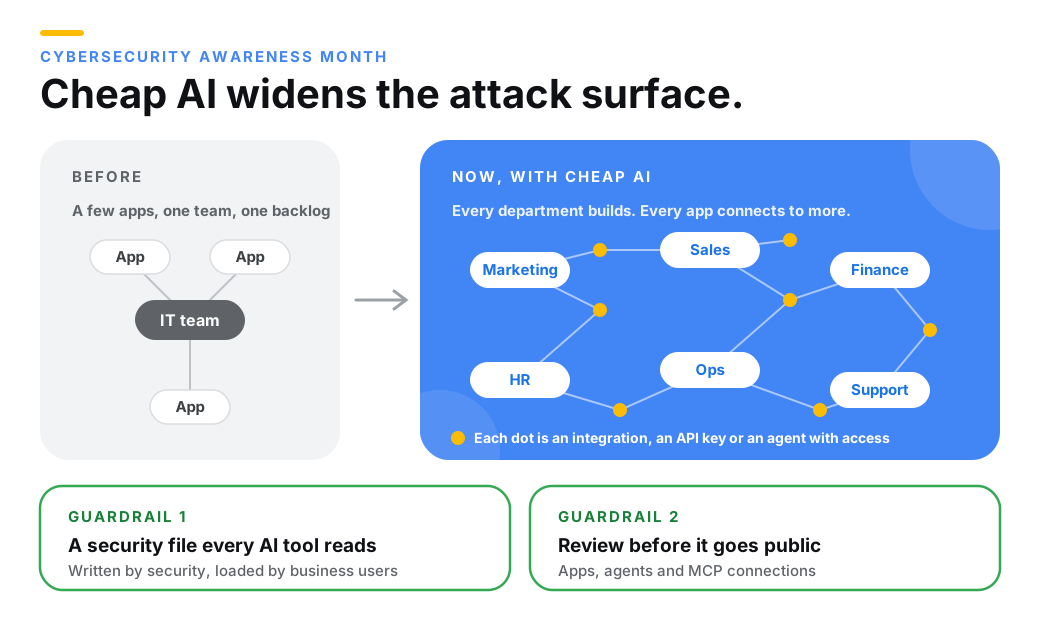
Attackers got the same deal. AI makes phishing, reconnaissance and malicious code cheaper and easier to scale. So AI lowers the cost of attacking a company and raises the cost of defending one, both at once.
The Numbers
IBM's Cost of a Data Breach Report from July 2026 found that one in four malicious breaches was AI-enabled, at $6 million each on average. More than one in five organizations had a breach aimed at their AI models or applications, and 27 percent of those came through compromised APIs, apps or plug-ins. That's the integration problem in one number.
The money is following. Gartner expects spending on securing AI to grow 83 percent this year, faster than any other part of the security market.
What I'd Ask Security Teams to Do
Educate the new builders. The marketer who built that lead tool is now a developer, whether they call themselves one or not. Nobody taught them why a password doesn't go in the code or why an app shouldn't have more access than it needs. And when a team replaces a vendor with an app it built in a week, the security work the vendor used to carry moves inside, to someone who has never done it. The license fee goes away. The responsibility doesn't. The yearly security video won't fix that. Short, practical lessons in the tools they build with will, along with someone who is responsible for securing those apps. Bringing them into the IT stack is new work for the CISO.
Write the rules down for the AI. As a starting point, give the new army of business developers guidance they can't miss. Claude, ChatGPT, Copilot and Gemini all read instructions from a simple file. If security writes one in plain language (what data stays out, where keys live, what an agent may connect to) every app a marketer builds starts with the rules built in. The AI reads it every time, even when the person doesn't.
Review early and build an information architecture of data flows. Review anything before it leaves localhost, the builder's own laptop, not when it's about to be shared with 200 people. Sit down with the builders while they're still building, and map where the data comes from, which AI models and vendors it passes through, and where it ends up. That map is what lets security see the whole picture instead of one app at a time. Keep the reviews short, or people will go around them. And count your website: an agent card or MCP server there is a public door too. MachineReady shows what your site exposes to AI.
Ask Your Vendors About Their AI
Your CRM, your email platform and your agencies are all adding AI, and sending your data to LLMs to do it. Verizon's 2026 Data Breach Investigations Report found a third party involved in 48 percent of breaches. A SOC 2 report from two years ago won't tell you which models a vendor uses or whether your data trains them. This prompt drafts the questions.
If You're One of the New Builders
Don't wait for security to find you. Tell them what AI you use, show them where your data goes, and bring them in early as a business partner. This prompt gets you ready for that conversation.
It isn't only the attackers using AI. It's every one of us building with it.
Are you bringing AI to your organization? Let's have a conversation. And I'd be happy to introduce you to one of my cybersecurity friends if you're in need of that help as well.
*Sources: IBM and Ponemon Institute, "Cost of a Data Breach Report 2026," July 2026, 602 organizations. Gartner, securing AI forecast, August 26, 2026. Verizon, "2026 Data Breach Investigations Report," more than 22,000 confirmed breaches. Anthropic, Form S-1, October 26, 2026 (2025 operating expenses of $12.6 billion on revenue of $4.6 billion). Edgile figures from Wipro's acquisition announcement, December 20, 2021.*
← Back to all articles