A line from an old colleague has been stuck in my head for weeks. This is about why, and what I think leaders should do about it.
Why does AI make yesterday's way of working hard to defend?
Most processes were designed around what people's time cost: research once a quarter, reports that look backward, ideas waiting in someone's queue. AI has cut that cost, but most processes haven't changed with it. Once you get something done in an afternoon that used to take weeks of handoffs, the old way is hard to justify. The test is simple: after you count review time, mistakes, cost and risk, is the result better? If it is, the old way needs a real reason to stay.
AI Summary
Summary by AI- Jeremy Fong, VP of Product at OPSWAT: "AI doesn't just speed up the work. It makes the old way indefensible."
- Most processes were built around what people's time used to cost. AI has made that time much cheaper, but the processes haven't caught up.
- Gallup (May 2026, more than 22,000 U.S. workers): 52 percent use AI in their role, 30 percent use it a few times a week or more and 15 percent every day.
- Speeding up each step helps. The bigger win is wiring the steps together, so what the market teaches goes straight into the next round instead of into a slide deck.
- Licenses and seats are an early sign of engagement, much as expense reports show a sales team's customer engagement. Usage, and later outcomes, come next.
- McKinsey (August 2026): nearly nine in ten companies use AI regularly and 37 percent see an impact on profit. Nearly three quarters of the 6 percent of high performers have redesigned workflows because of AI.
- Suggested start: pick one workflow the team runs every week, rebuild it with AI, measure it honestly including review time, then share it with the rest of the team.
Jeremy
Jeremy Fong and I have worked together at four companies: media.net, NBC, Ribbit and Jibe. BT bought Ribbit in 2008 (here's BT's side of that story), and Google bought Jibe in 2015 (here's the hackathon we ran along the way, where Jeremy was a judge on the panel).
Jeremy is an incredible leader in the C-suite. He was great from day one, and he's only gotten better. What I've always noticed is how he works. He spots the opportunity before most people do, then puts a process and a lot of brainpower behind it. And he's amazing with people. Being smart and organized is one thing. Getting a team to actually want to change how they work is another, and Jeremy does both. He doesn't fall in love with the idea, and he doesn't keep a process around just because it's always been there.
So when Jeremy put this into words, I wrote it down:
"AI doesn't just speed up the work. It makes the old way indefensible."
It Starts With Speed
I've felt this in my own work. At first AI just made me faster. Research took an hour instead of a day. First drafts stopped being painful. An idea I mentioned in a meeting could be a working prototype before the meeting ended.
Then I started asking probing questions about the process around the work. Why does this step exist? Who is it really for? What would happen if we did it differently? Why are we going to get the numbers? The numbers should be pushed to us. Why does testing a small idea need a budget, a brief and a slot in someone's queue? Just build the prototype and let's review a working solution.
Usually there's no good answer. The process made sense once, and nobody reinvented how we worked.
Some people haven't had that moment yet. In Gallup's May 2026 survey of more than 22,000 U.S. workers, 52 percent said they use AI in their role. But only 30 percent use it a few times a week or more, and just 15 percent use it every day. Fewer than half (47 percent) said their organization has brought in AI tools at all, and one in five didn't know.
And even when people have a tool, the question is whether it's the right tool for the work they actually do. My sense is that a lot of people still aren't moving outside the $20-a-month box: one chat subscription, used for drafts and quick questions, and not connected to anything else. Some won't even buy that themselves. They use whatever their organization provides, and a lot of organizations are being conservative. That means they can't learn what the better tools can do. If you work in marketing, or really any profession, you need to be on all the AI tools, not just one, and understand which one is good, better and best for each job. There's an unlock that shows up when you know what you can really do.
Here's what I mean. The old way might be building a spreadsheet in an hour to get organized. The new way might be a collaborative app with a database, an AI chat interface, self-learning code and login through your favorite identity provider. And it still takes an hour.
So for many teams, the old way hasn't been tested yet.
Built for What Work Used to Cost
Most companies built their processes around what people's time cost. Research happens once a quarter because someone has to do it. Reports look backward because pulling the data takes days. Good ideas wait because the people who could build them are busy.
None of that was wrong when it was set up. But when the cost changes and the process doesn't, a sensible decision turns into an expensive habit.
Wire the Steps Together
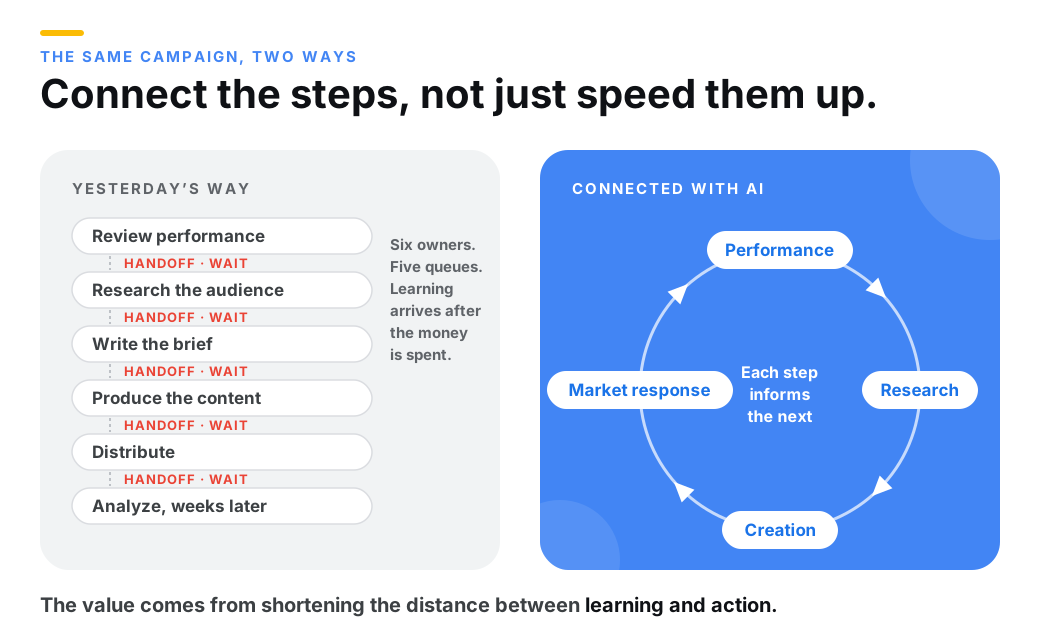
Take a typical campaign. One person looks at last quarter's results. Someone else researches the audience. A third person writes the brief. Then production, then distribution, and weeks later someone finally looks at how it did. Every step is a handoff, and every handoff is a wait.
You can use AI to speed up each of those steps, and you'll get something out of it. The bigger win is wiring them together, so what you learn from the market goes straight into the next round instead of into a slide deck.
I want to be careful here, because I've also seen this go wrong. Faster isn't automatically better. A team can crank out three times the content and learn nothing. You can automate a report nobody reads. You can get polished work that someone then spends a day fixing.
So the test I use is simple. After you count the review time, the mistakes, the cost and the risk, is the result better? If it is, the old way needs a pretty good reason to stick around.
Using Cost to Measure Your Start
I think cost is a good way to measure where you're starting. Licenses and seats are an early sign of engagement, and right now we are surely at the start. Later, outcomes will be how we measure AI, the same way we measure everything else. But at the start, when you want people to explore and get creative, you might need to reward the opposite: people trying things, even before there's a result to show. Imagine if your CFO said, "We want you to spend more on AI. You aren't spending enough on AI."
A lot of people still don't have access to the tools, and plenty who do never open them. The machines are moving much faster than the humans. Knowing who has a seat, and who actually uses it, tells you where your team really is.
Here's an idea that's a little outside the box. Nobody measures AI this way yet, but you could. Think about how you'd judge a sales team's customer engagement. You'd look at their expense reports: who's taking customers to lunch, who's getting on planes, who's out building relationships. AI is no different. Start with seat costs to see whether your teams are even trying. Then look at usage logs or token consumption to see who's really using it. Just leave out the agent jobs, which burn most of the tokens, so you see what people are doing themselves.
I made a similar case in My CFO Cut My Marketing Budget and Said: Use AI: AI spend is one of the best ways to see how mature a marketing team is. Seats come first. Then you look for real usage, API spend across several tools, and tools connected to real workflows.
Spend tells you who's trying. It doesn't tell you what changed. So I'd also ask: what do we do better every week because we have AI? If nobody can name a workflow and a result, the spend hasn't paid off yet.
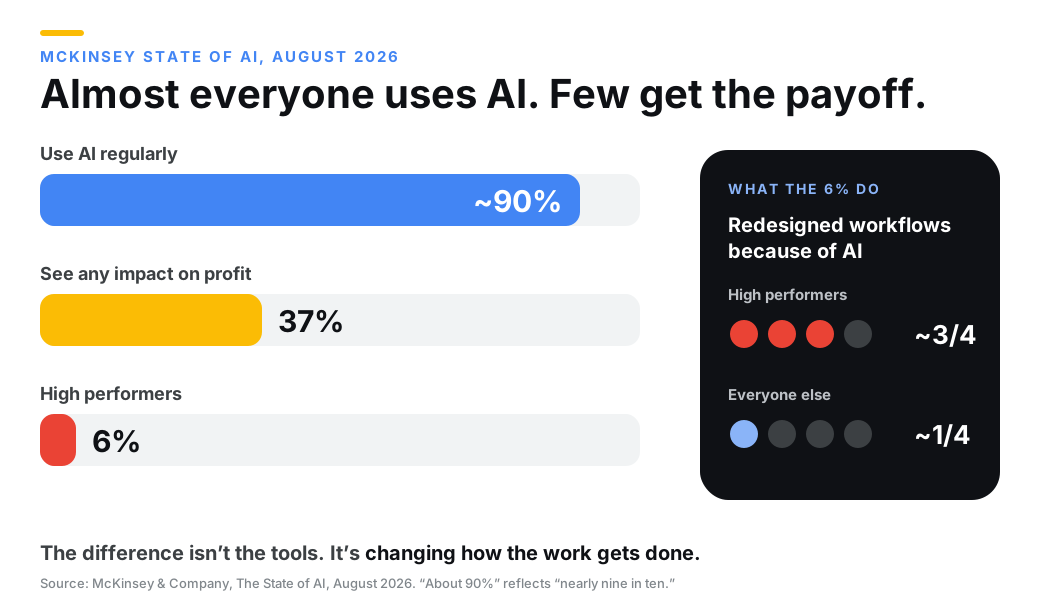
McKinsey's numbers point the same way. In its State of AI survey from August 2026, nearly nine in ten companies say they use AI regularly, but only 37 percent see any impact on profit, about the same as a year ago. The 6 percent McKinsey calls high performers look different: nearly three quarters of them have redesigned workflows because of AI. Among everyone else, it's about one in four.
Not Every Approval Is Friction
Some approvals are there for good reasons. They protect customers, money and sensitive data, and they should stay. Others are there because nobody ever questioned them. AI gives you a reason to look at both. Keep the ones that matter, drop the ones that don't, and be clear about who owns the result either way.
Who Makes the Old Way Indefensible
It usually isn't the most senior person in the room. At Cannes Lions this year, the CMOs of Google, OpenAI and JPMorganChase talked about the marketers they're betting on, and called them makers and builders. Plenty of them are junior people who got tired of doing something by hand and automated it. JPMorganChase's Carla Hassan made a point I agree with, too: a campaign "is still a process," and if you skip steps to go faster, something eventually breaks.
The people who go furthest are what I call Marketing Super-Creators, marketers who stop just using AI and start building with it. Honestly, it's what I've watched Jeremy do for years. See the opportunity, put a process and real thinking behind it, bring the people with you, and don't keep the old way just because it's there.
Where I'd Start
Pick one workflow your team runs every week or every month. Write down what it costs today and where it gets stuck. Rebuild it with AI, run it for a couple of weeks, and count everything, including the time spent checking and fixing.
If it's better, get the rest of the team using it. One person's clever shortcut doesn't help the company until other people can use it too.
If you want help picking the first one, paste this into ChatGPT, Claude or whatever you use. It'll interview you about one workflow and give you a plan to test.
Let the Old Way Go
The way most of us work today was designed for limits that are disappearing. When something better proves itself, let the old way go.
Once you've seen what's possible, the question flips. Nobody has to justify trying the new way anymore. Someone has to explain why the work still happens the old way.
Want help picking the first workflow to redesign? Get in touch with Dan Seyer, or run MachineReady on your website, a tool we built to show how AI reads your site.
*Sources: Gallup, "Organizational AI Adoption Jumps Six Points," July 2026, survey of 22,573 employed U.S. adults, May 6 to 20, 2026. McKinsey & Company, "The State of AI," August 2026.*
← Back to all articles